
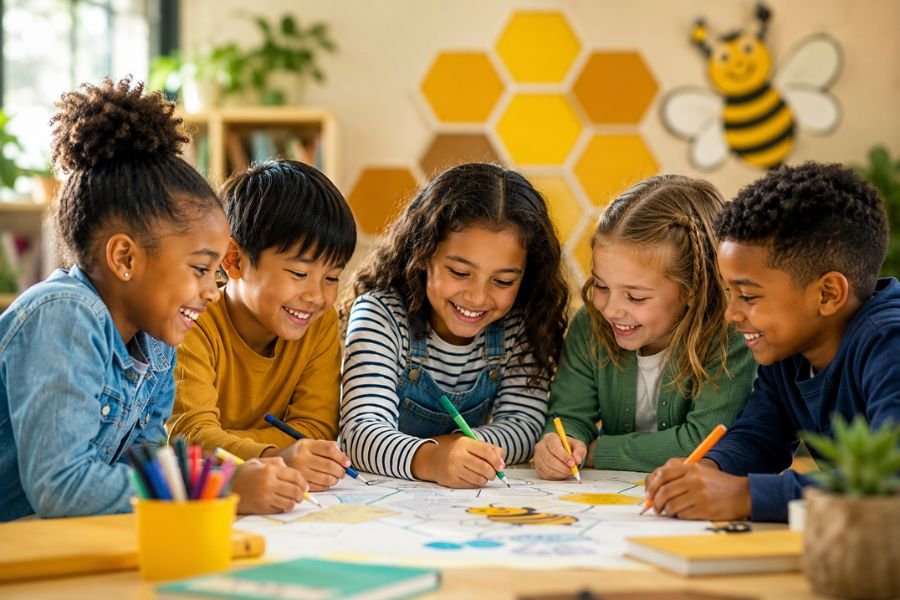
Practical Ways to Build Emotional Intelligence, Community, and Engagement Through Everyday Learning
In classrooms across the country, educators are being asked to do more than ever before. Teachers are not only expected to support academic growth—they are also helping children navigate emotions, build friendships, solve conflicts, develop confidence, and learn how to exist in community with others.
At the same time, many students are arriving in classrooms carrying big emotions, shorter attention spans, social anxiety, communication challenges, and a growing need for meaningful connection. Traditional approaches to learning often leave little room for emotional development, reflection, collaboration, or relationship-building.
That’s where the Bee-Conomy’s 7 C’s Framework comes in.
The 7 C’s—Curiosity, Compassion, Communication, Connection, Cooperation, Collaboration, and Community—create a shared language that helps children better understand themselves and others while building the foundational life skills needed for both academic and personal success.
The framework is intentionally flexible. It is not designed to replace curriculum standards or overwhelm teachers with “one more thing.” Instead, it acts as a lens educators can use to transform existing classroom experiences into richer, more emotionally intelligent learning opportunities.
Whether you teach Kindergarten, elementary, after-school programs, homeschool groups, or enrichment classes, the 7 C’s can become woven naturally into your classroom culture, routines, projects, and conversations.
What Are the 7 C’s?
The Bee-Conomy’s 7 C’s framework gives children a memorable and practical way to think about relationships, learning, and growth.
The framework includes:
1. Curiosity
Encouraging children to ask questions, explore ideas, investigate possibilities, and remain open to discovery.
2. Compassion
Helping students recognize emotions, care for others, practice empathy, and respond thoughtfully to people around them.
3. Communication
Teaching children how to express thoughts, feelings, needs, and ideas clearly and respectfully.
4. Connection
Building healthy relationships and helping students understand the importance of belonging and shared experiences.
5. Cooperation
Supporting teamwork, shared responsibility, patience, and problem-solving together.
6. Collaboration
Encouraging learners to combine ideas, create together, and value multiple perspectives.
7. Community
Helping students recognize that they are part of something larger than themselves and that their actions impact others.
Together, these principles help classrooms shift from simply managing behavior to intentionally cultivating emotional intelligence, self-awareness, and positive culture.
Why the 7 C’s Matter in Today’s Classrooms
Many educators already understand that children learn best when they feel emotionally safe, connected, and engaged. Yet schools often lack practical systems for embedding those skills into everyday learning experiences.
The Bee-Conomy framework was designed to help bridge that gap.
When children practice the 7 C’s consistently, classrooms often experience:
- Improved peer relationships
- Better communication skills
- Increased classroom participation
- Stronger emotional regulation
- More collaborative learning
- Increased empathy and kindness
- Reduced social conflict
- Greater student ownership
- Stronger classroom identity
- Higher engagement through interactive learning
Importantly, the framework works because it moves beyond abstract conversations about behavior and instead gives children concrete language and repeated opportunities to practice these ideas in real situations.
The 7 C’s are not taught once and forgotten. They are experienced.
The Difference Between Teaching Skills and Practicing Them
One of the most important ideas behind the Bee-Conomy approach is this:
We don’t just teach skills—we help children practice them, experience them, and carry them into real life.
For example:
A child does not fully learn cooperation from hearing a definition on a worksheet.
They learn cooperation when:
- They work through frustration during a group challenge
- They negotiate ideas during a creative activity
- They share materials during a classroom project
- They help another student complete a task
- They experience what teamwork actually feels like
Similarly, communication grows through:
- Circle discussions
- Reflection exercises
- Storytelling
- Collaborative games
- Partner activities
- Student-led conversations
The Bee-Conomy framework emphasizes active participation, imaginative play, storytelling, and reflective learning because children absorb social-emotional skills best through lived experiences.
How to Integrate the 7 C’s Into Daily Classroom Life
One of the strengths of the framework is that it can be embedded into what teachers are already doing.
You do not need to redesign your entire classroom.
Small intentional shifts create powerful outcomes over time.
Morning Meetings & Opening Circles
Morning meetings are one of the easiest places to integrate the 7 C’s naturally.
Curiosity Prompts
- “What’s something you’ve been wondering about lately?”
- “What’s one thing you’d love to learn more about?”
Compassion Questions
- “How can we help someone today?”
- “What does kindness look like in action?”
Communication Activities
- Partner shares
- Feeling check-ins
- Story retelling
- Discussion prompts
Connection Builders
- Shared classroom goals
- Common interests webs
- Compliment circles
These moments create emotional grounding before academic instruction even begins.
Using the 7 C’s During Academic Lessons
The framework works beautifully across subject areas.
Reading & Language Arts
Students can:
- Identify character emotions (Compassion)
- Analyze motivations (Connection)
- Practice speaking and listening (Communication)
- Collaborate during group storytelling activities (Collaboration)
Teachers can ask:
- “What might this character be feeling?”
- “How did they solve this problem together?”
- “What would you do differently?”
Science
Science naturally encourages Curiosity.
Students can:
- Explore hypotheses
- Conduct experiments
- Work in research teams
- Reflect on discoveries together
The Bee-Conomy framework transforms science from simply “finding answers” into collaborative exploration.
Math
Math lessons can reinforce:
- Cooperation during partner problem-solving
- Communication through explaining reasoning
- Collaboration during group strategy work
Students begin understanding that learning itself is a shared experience.
Social Studies
Community becomes especially powerful during social studies instruction.
Students can:
- Explore cultural perspectives
- Learn about civic responsibility
- Understand how communities function
- Reflect on their role in society
This aligns closely with Bee-Conomy’s emphasis on belonging, empathy, and collective growth.
Play-Based Learning and Why It Works
The Bee-Conomy approach strongly supports play-based and experiential learning because play is one of the most effective pathways to engagement and emotional development.
The framework recognizes that:
- Play is not a distraction from learning
- Play is often the vehicle through which deeper learning happens
Bee-Conomy facilitation experiences intentionally use open-ended materials, collaborative tasks, and imagination-based activities to develop the 7 C’s organically.
For example:
- Loose puzzle pieces
- Letter blocks
- Random materials
- Story prompts
- Collaborative builds
- Creative problem-solving games
These experiences encourage:
- Divergent thinking
- Social interaction
- Creative confidence
- Shared ownership
- Communication
- Relationship-building
When children are invited to imagine together, they don’t just learn content—they learn how to belong.
The Role of Emotional Safety in Learning
Students participate more fully when they feel emotionally safe.
The 7 C’s help create that emotional safety by establishing classroom norms centered around:
- Respect
- Listening
- Inclusion
- Empathy
- Shared responsibility
- Positive identity-building
Children who feel emotionally connected are often:
- More willing to take academic risks
- More engaged in discussions
- More likely to participate collaboratively
- Better able to self-regulate
- More resilient when facing challenges
This is why social-emotional learning and academic growth are deeply connected—not separate systems.
Building Stronger Classroom Communities
Community is the final “C” because it represents the outcome of the others working together.
When students:
- Communicate effectively
- Practice compassion
- Collaborate consistently
- Feel connected
- Cooperate toward shared goals
…a true classroom community begins to form.
This does not happen overnight.
It is built through repeated shared experiences.
Teachers can strengthen community by:
- Creating collaborative traditions
- Celebrating group accomplishments
- Using team-based challenges
- Encouraging student voice
- Incorporating reflection activities
- Giving students leadership opportunities
The Bee-Conomy framework refers to this collective identity-building as becoming part of the “Hive.”
Family Engagement and Extending the 7 C’s Beyond School
One of the most powerful aspects of the framework is that the language can continue beyond the classroom.
Families can reinforce:
- Compassion at home
- Communication during routines
- Cooperation between siblings
- Curiosity through exploration
- Community through service and shared experiences
Because the 7 C’s are simple and memorable, children can begin identifying them in everyday life.
Examples:
- “That was compassionate.”
- “We collaborated on that.”
- “You showed curiosity.”
- “We worked as a community.”
This consistency between school and home helps deepen learning and emotional growth.
Supporting Different Learning Styles
The Bee-Conomy framework is intentionally flexible and multi-modal.
Students engage through:
- Storytelling
- Visual learning
- Hands-on activities
- Group discussion
- Movement
- Reflection
- Creative expression
- Interactive challenges
This allows diverse learners to participate in ways that feel natural and accessible to them.
The framework also reduces pressure around “getting the right answer” and instead emphasizes:
- Exploration
- Participation
- Growth
- Reflection
- Shared learning
That shift alone can dramatically increase student confidence and engagement.
The Long-Term Impact of the 7 C’s
The goal of the framework is not simply classroom management.
The larger vision is helping children develop lifelong emotional and social tools.
These are the same skills students will eventually need in:
- Friendships
- Leadership
- Careers
- Families
- Team environments
- Community spaces
- Creative problem-solving situations
The Bee-Conomy framework helps students begin building those foundations early through consistent practice and joyful engagement.
Final Thoughts: Creating a Classroom Where Children Belong
At its heart, the 7 C’s framework is about helping children feel:
- Seen
- Heard
- Valued
- Connected
- Empowered
It is about creating learning environments where emotional intelligence is not treated as secondary to academics—but essential to it.
The Bee-Conomy believes classrooms thrive when children are given opportunities to:
- Explore curiously
- Communicate openly
- Collaborate creatively
- Build meaningful relationships
- Contribute to their communities
Because when students learn how to work together, reflect together, and grow together, education becomes more than instruction.
It becomes transformation.
And in the Hive, every child has a place to belong.