
Why Play-Based Learning Helps Children Build Confidence, Empathy, and Emotional Awareness
Children are constantly learning how to understand the world around them—but perhaps even more importantly, they are learning how to understand themselves.
Every interaction, frustration, success, disagreement, and moment of curiosity becomes an opportunity for emotional growth. Yet for many children, especially in early childhood settings, emotions can feel big, confusing, and difficult to express with words.
That’s where play becomes powerful.
Play is not simply entertainment. It is one of the most natural and effective ways children develop emotional intelligence, communication skills, empathy, self-regulation, and confidence. Through imaginative experiences, collaborative games, storytelling, movement, and creative exploration, children learn how to process feelings, solve problems, navigate relationships, and connect with others in meaningful ways.
At The Bee-Conomy, we believe emotional intelligence should not feel like a lecture—it should feel like discovery. Through playful learning environments rooted in curiosity, compassion, collaboration, and connection, children develop the social and emotional tools they need to thrive in classrooms, homes, and communities.
What Is Emotional Intelligence?
Emotional intelligence—often called EQ—is the ability to:
- Recognize emotions
- Understand feelings
- Express emotions appropriately
- Manage reactions
- Build healthy relationships
- Show empathy toward others
- Solve social conflicts effectively
For young children, these skills are not automatic. They are learned through repetition, modeling, reflection, and experience.
A child learning emotional intelligence might be:
- Learning how to calm down after frustration
- Recognizing when a friend feels sad
- Practicing taking turns
- Learning to ask for help
- Building confidence to share ideas
- Understanding that emotions are temporary and manageable
These experiences become foundational life skills that support academic achievement, relationships, resilience, and mental wellness later in life.
Why Play Matters in Emotional Development
Children often communicate emotions through play before they can fully explain them verbally.
When children pretend, build, create, collaborate, and imagine, they naturally practice:
- Perspective-taking
- Communication
- Decision-making
- Emotional regulation
- Cooperation
- Creativity
- Problem-solving
Play also lowers pressure.
In structured “lesson-only” environments, children may feel nervous about giving the “right answer.” But during playful experiences, children become more willing to:
- Take social risks
- Express emotions
- Collaborate with peers
- Experiment with ideas
- Recover from mistakes
This is one reason play-based environments are so effective in both classrooms and childcare settings.
As children engage with others, they begin learning an important truth:
Their feelings matter—and so do the feelings of others.
The Research Behind SEL & Play-Based Learning
Social-emotional learning (SEL) is not just a trend—it is one of the most researched and effective approaches in early childhood education.
Research from CASEL (Collaborative for Academic, Social, and Emotional Learning) has shown that high-quality SEL programs can improve:
- Emotional regulation
- Classroom behavior
- Academic performance
- Peer relationships
- Long-term confidence and resilience
Studies have also found that students participating in SEL programs demonstrate:
- Improved attitudes toward learning
- Reduced emotional distress
- Better cooperation and communication skills
- Stronger academic outcomes
Play-based learning environments have similarly been linked to:
- Increased engagement
- Better memory retention
- Improved language development
- Enhanced creativity
- Stronger social skills
In other words: when children feel emotionally safe and engaged, learning becomes deeper and more meaningful.
What Emotional Intelligence Looks Like in Early Childhood
Emotional intelligence in children rarely looks perfect or polished.
It looks like:
- A child taking a deep breath instead of yelling
- A student asking, “Are you okay?”
- Children working through a disagreement together
- A shy child finally sharing during circle time
- A child recognizing frustration and asking for help
These moments may seem small, but they are incredibly important.
Emotional growth happens gradually through repeated experiences and supportive environments.
The Role of Child Care Providers & Educators
Child care providers are often among the first people to help children navigate social and emotional experiences outside the home.
This role is incredibly powerful.
Educators and providers help children:
- Build emotional vocabulary
- Learn routines and self-regulation
- Practice empathy
- Develop confidence
- Understand boundaries
- Navigate friendships
- Feel safe expressing themselves
In many ways, classrooms and childcare programs become practice spaces for life.
That’s why emotionally supportive environments matter so deeply.
Classroom & Daycare Tips That Support Emotional Intelligence
1. Create Emotional Check-In Routines
Start the day with emotional awareness.
Simple prompts like:
- “How are you feeling today?”
- “What kind of energy do you have today?”
- “What’s one thing you’re excited about?”
help children begin identifying and naming emotions.
Younger children can use:
- Emotion cards
- Color systems
- Feeling charts
- Bee-themed mood check-ins
Consistency helps children normalize emotional expression.
2. Use Collaborative Activities Instead of Constant Competition
Healthy collaboration teaches:
- Listening
- Patience
- Communication
- Problem-solving
- Shared success
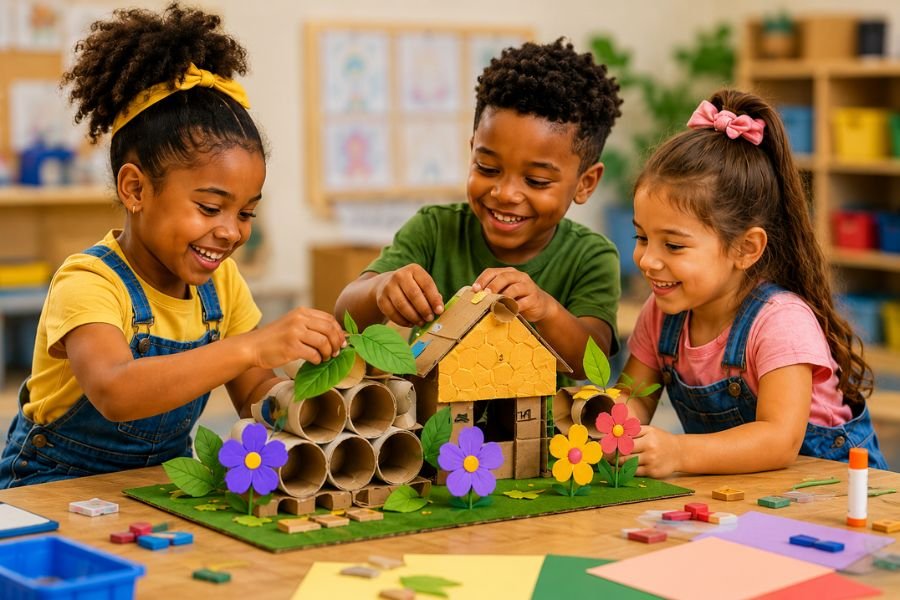
Group art projects, building challenges, storytelling games, and team missions encourage children to work together instead of always trying to “win.”
This aligns closely with The Bee-Conomy’s 7 C’s principles of:
- Communication
- Cooperation
- Collaboration
- Community
3. Model Emotional Language
Children learn emotional regulation by watching adults.
Instead of:
- “Stop crying.”
- “You’re fine.”
- “Calm down.”
Try:
- “I see that you’re frustrated.”
- “That felt upsetting to you.”
- “Let’s take a breath together.”
- “Would you like help solving the problem?”
When adults model emotional awareness calmly, children begin internalizing those same responses.
4. Build Reflection Into Activities
Reflection helps children connect actions to emotions.
After activities, ask:
- “How did that feel?”
- “What was challenging?”
- “What helped your team work together?”
- “How did you help someone today?”
Reflection transforms experiences into emotional learning opportunities.
Example Activity: The Bee Team Build Challenge
Objective
Help children practice communication, collaboration, emotional regulation, and teamwork.
Materials
- Building blocks
- Recycled materials
- Paper cups
- Craft sticks
- Tape
- Small toy bees or bee images
Instructions
Divide children into small “Bee Teams.”
Challenge each group to build:
- A bee hive
- A bridge
- A kindness garden
- A pollinator station
The catch:
Each child must contribute at least one idea.
Encourage teams to:
- Listen to one another
- Solve disagreements respectfully
- Share materials
- Celebrate teamwork
Reflection Questions
After the activity, ask:
- What helped your team work together?
- How did you solve problems?
- Did anyone help encourage someone else?
- What emotions came up during the challenge?
- What made your group successful?
This simple activity develops far more than creativity—it helps children practice real emotional and social skills in action.